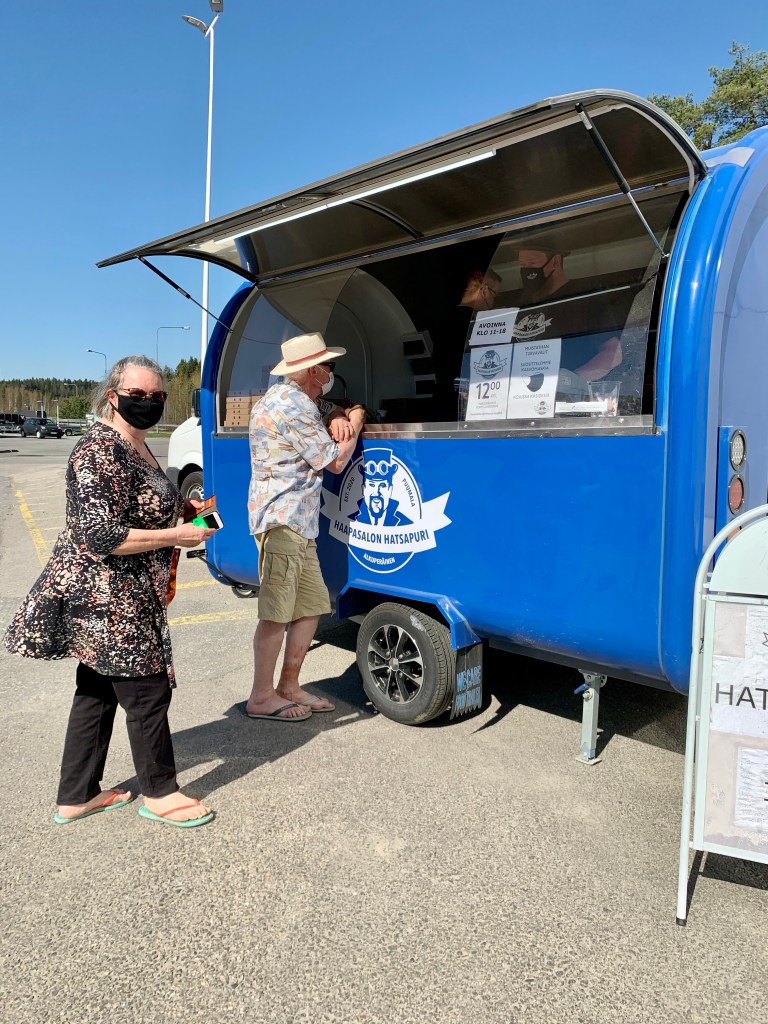
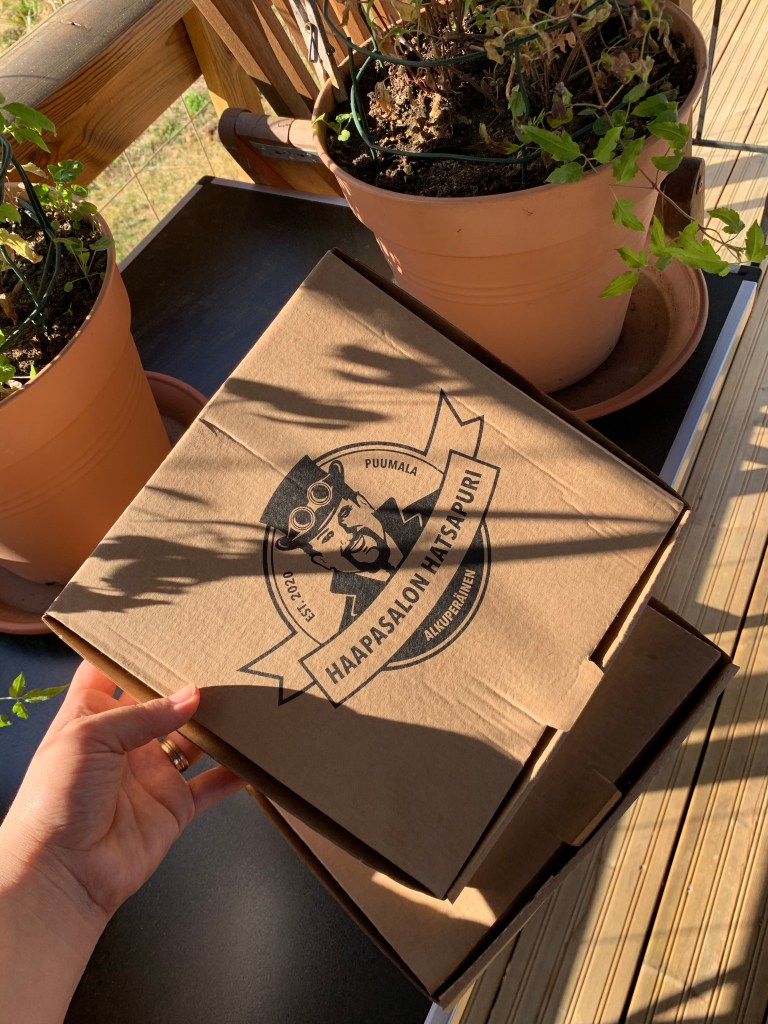
Hoje “conheci” Ville Haapasalo, ator, escritor, apresentador e empresário. Digo “conheci” porque eu, na verdade, não cheguei muito perto por estar gripada… então só vi e cumprimentei de longe mesmo. Mas, enfim, ele estava aqui pertinho de casa apresentando (ou melhor dizendo, vendendo) o Hatsapuri, um pãozinho de queijo que ele trouxe da Geórgia, que é uma delícia!
Descobri o hatsapuri através do meu sogro (que está ali na foto conprando alguns pra gente), que fez a receita em sua casa e me deu um pãozinho. Claro que, como viciados em queijos, aqui em casa todos amamos o hatsapuri. Pedi a receita e eu mesma fiz algumas vezes em casa.
Ele tem um programa onde costuma viajar para alguns lugares e aprender receitas locais, é bem interessante. Hatsapuri é uma dessas receitas e veio da Georgia. Agora ele viaja para ao redor da Finlândia com seu trailer e bastante hatsapuri pra vender, se você mora na Finlândia, pode conferir no site as datas e locais do trailer dele (e quando ele mesmo vai estar por lá).
EN
Today I “met” Ville Haapasalo, actor, writer, TV host and entrepreneur. I said “I met” because I actually didn’t get very close to him since I have flu… so I just saw and greeted him from a distance. But, anyway, he was here close to where we live introducing (or I’d rather say, selling) Hatsapuri, a cheese kinda bread that he brought from Georgia, which is delicious!
I first heard about hatsapuri from my father-in-law (who is there in the picture buying some for us), who made the recipe at his place and gave me one for taste. Of course, as cheese addicts, here at home we all loved hatsapuri. I asked him for the recipe and made it myself at home a few times.
Thai guy has a TV show in which he travels to some places and learn their local recipes, it is very interesting. Hatsapuri is one of those recipes and came from Georgia. Now he travels around Finland with his trailer and a lot of hatsapuri to sell, if you live in Finland, you can check on the website the dates and places where he’d be with his trailer (and even when he will be there himself).
Hoje completo 5 anos de blog! Uau! Como o tempo voa! Cinco anos contando à vocês minhas experiências em terras finlandesas. Por isso, resolvi que no post de hoje vou compartilhar 5 costumes finlandeses que adquiri ao longo desse tempo.
1. Agradecer mais. Uma das coisas que eu percebi primeiro por aqui e logo tratei de me apegar, foi o hábito de agradecer. Por aqui você agradece ao motorista de ônibus quando desce do ônibus, ao pessoal do restaurante quando deixa o restaurante, ao terminar uma refeição e por aí vai. Provavelmente a palavra mais ouvida por aqui (e a primeira que aprendi) é “kiitos”, que quer dizer obrigado, em finlandês. Não estou dizendo que não costumamos agradecer no Brasil, mas que por aqui se agradece muito mais e desde cedo (meu filho, por exemplo, quase nem fala ainda, mas já solta um “kiki” diversas vezes ao dia). E eu me apeguei tanto a este hábito, que faço o tempo todo em finlandês, português ou inglês, onde quer que eu esteja.
2. Um pão só. Talvez esse seja mais difícil de explicar, mas, no Brasil, quando você fala que vai comer um pãozinho com presunto e queijo, por exemplo, você quer dizer: pão + queijo + presunto + o pãozinho que vai fechar. Pois por aqui não há o hábito de fechar com um segundo pãozinho. Na verdade seria: pão + queijo + presunto e só. Melhor dizendo, normalmente teria em cima tomate, pepino ou páprica e uma folhinha de alface.
3. Tirar os calçados ao entrar em casa. Eu sei que agora, com a pandemia, este se tornou um hábito no mundo todo. Mas aqui já é costume desde sempre. Confesso que no começo eu dava uns passinhos pra dentro e “ops! esqueci de tirar o calçado”. Mas hoje em dia é tão natural que, quando visito meus pais, no Brasil, eu acabo tirando os sapatos também por lá. Uma vez (bem antes de vir pra cá, quando eu comecei a namorar meu, hoje, marido e pesquisava tudo que podia sobre cultura finlandesa) eu li algo bem interessante dizendo que esse costume vem de não trazer nada de fora pra casa. É uma forma bem profunda (e prática) de dizer que seus problemas de fora, assim como a sujeira, ficam pra fora, eles não entram na sua vida pessoal, ou na sua casa.
4. Churrasco finlandês. Este talvez seja um costume polêmico. Afinal de contas, venho de uma das regiões do Brasil que mais exporta carne bovina pro mundo e faz churrasco com bastante frequência! Não deixei e nem deixarei de gostar do churrasco brasileiro, principalmente porque não estamos falando só de assar a carne, mas de estar com amigos preparando tudo juntos, escutando uma boa música, conversando… é todo um evento. Mas estou dizendo que eu também aprendi a gostar do churrasco finlandês e aqui eu incluiria também a refeição finlandesa de uma forma geral, que é simples e saboroso. Feito, principalmente, com boas salsichas na grelha, talvez alguns vegetais também e queijos (aliás, se você nunca provou um queijo grelhado… fica a dica, experimente!). Ah! E o churrasco finlandês também é um evento, já que são poucos os meses que você vai estar ao ar livre, então durante este período a gente aproveita pra fazer churrasco sempre que possível para aproveitar.
5. Aproveitar ao máximo a (e da) natureza. Sim, a gente aproveita bastante ao ar livre no Brasil. Mas eu diria que por lá a gente senta mais no sofá e assiste tv do que por aqui. Aqui as pessoas têm mais o hábito de se exercitar ao ar livre (inclusive finlandeses são conhecidos por este costume… não eu, eu ainda preciso deixar de ser sedentária e me exercitar mais) e estar ao ar livre, com seu próprio kit churrasco ou fazendo uma pequena fogueira à beira de um lago. Por aqui, as pessoas colhem e se alimentam de muito do que a natureza produz, aliás já mencionei muitas vezes o quanto amo colher cogumelos e frutinhas da floresta.
Talvez eu tenha mais costumes finlandeses que eu tenha adquirido e não tenha percebido ainda. Mas estes, com certeza, são os que eu mais vejo no meu dia a dia. E aí, será que algum destes costumes você gostaria de incluir na sua vida também?
EN
Five years ago today I started this blog! Wow! Time flies! Five years telling you about my experiences in Finnish lands. So I decided that in today’s post I will share 5 Finnish habits that I acquired over this time.
1. Thank more. One of the things that I first noticed here and soon tried to practice to, was the habit of thanking. Here you thank the bus driver when you get off the bus, the restaurant staff when you leave the restaurant, after you end a meal and so on. Probably the most heard word here (and the first one I learned) is “kiitos”, which means thank you, in Finnish. I am not saying that we do not usually thank in Brazil, but that here we are saying it much more and from an early age (my son, for example, almost doesn’t even speak yet, but he lets out a “kiki” several times a day). And I got so attached to this habit, that I do it all the time in Finnish, Portuguese or English, wherever I am.
2. One bread only. Perhaps this is more difficult to explain, but in Brazil, when you say you are going to eat a bread with ham and cheese, for example, you mean: bread + cheese + ham + the other bread or half that will close. But here there is no habit of closing with a second bread. In fact it would be like this: bread + cheese + ham and that’s it. Well, actually, it would have tomato, cucumber or paprika on top and maybe a leaf of lettuce as well.
3. Take off your shoes when entering the house. I know that now, with the pandemic, it has become a habit all over the world. But it has always been a custom here. I confess that at the beginning I took a few steps inside and “ops! I forgot to take off my shoes ”. But nowadays it is so natural that when I visit my parents in Brazil, I end up naturally taking off my shoes there too. Once (well before I came here, when I started dating my husband, I was researching everything I could about Finnish culture) I read something very interesting saying that this habit comes from not bringing anything to home. It is a very deep (and practical) way of saying that your problems from outside, as well as dirt, are left out, they do not enter your personal life, or your home.
4. Finnish barbecue. This is perhaps a controversial habits . After all, I come from one of the regions of Brazil that exports cow meat to the world and of course we eat there barbecue quite often! I did not and will not stop enjoying the Brazilian barbecue, mainly because we are not just talking about roasting the meat, but being with friends preparing sides together, listening to a good music, having great conversations… it is all an event. But I am saying that I also have learned to like the Finnish barbecue and here I would also include the Finnish meals in general, which are simple and tasty. Made mainly with good sausages on the grill, maybe some vegetables and cheeses too (in fact, if you’ve never tasted a cheese made on grill… here’s the tip, try it!). Ah! And the Finnish barbecue is also a big event, since there are few months that you will be outdoors, so during this period we would barbecue whenever possible.
5. Make the most of nature. Yes, we enjoy a lot outdoors in Brazil. But I would say that over there we sit more on the couch and watch TV than here. Here people are more into exercising outdoors (they are well known about this… well, not me, I still need to stop being sedentary and exercise more) or just spend some good time outdoors, including taking own barbecue kit or making a small fire pit by the side of a lake. Around here, people harvest and eat much of what nature produces, and I have already mentioned many times here how much I love picking mushrooms and berries from the forest.
Perhaps I have acquired more Finnish habits than I have realized. But these, for sure, are the ones I see most in my daily life. So, is there any of these habits you would like to include in your life as well?
O convite mais esperado do ano veio pra mim na semana passada. Uma mensagem de texto da cidade para que eu agendasse meu horário para a vacina contra COVID-19. E eu resolvi então dividir com vocês uma atualização de como está a situação na Finlândia em relação à pandemia.
Antes de tudo, queria dizer que não, a vacina não está na minha faixa etária ainda. Na minha casa, somente eu recebi a vacina, pois sou diabética. A vacina ainda está entre os idosos e os de grupo de risco.
Neste link você consegue ver, por exemplo, em que ordem as vacinas estão sendo dadas. Começando pelos profissionais que estão cuidando de pacientes com COVID-19, passando por idosos com mais de 80, entre 75-79, entre 70-74 anos de idade e agora estamos nos grupos de risco com predisposição ao agravamento da doença. Quando o número de vacinados for significativamente alto, então, serão chamados os que têm uma boa saúde. Enfim, segue mais ou menos a ordem que a maioria dos países estão seguindo também.
Como brasileira, posso dizer que a situação na Finlândia está bem tranquila em relação ao COVID-19. O número de casos, internados em tratamento intensivo e mortos não se compara ao caos que está acontecendo no Brasil. E, sim, os números do Brasil estão tão altos que são notícia por aqui também.
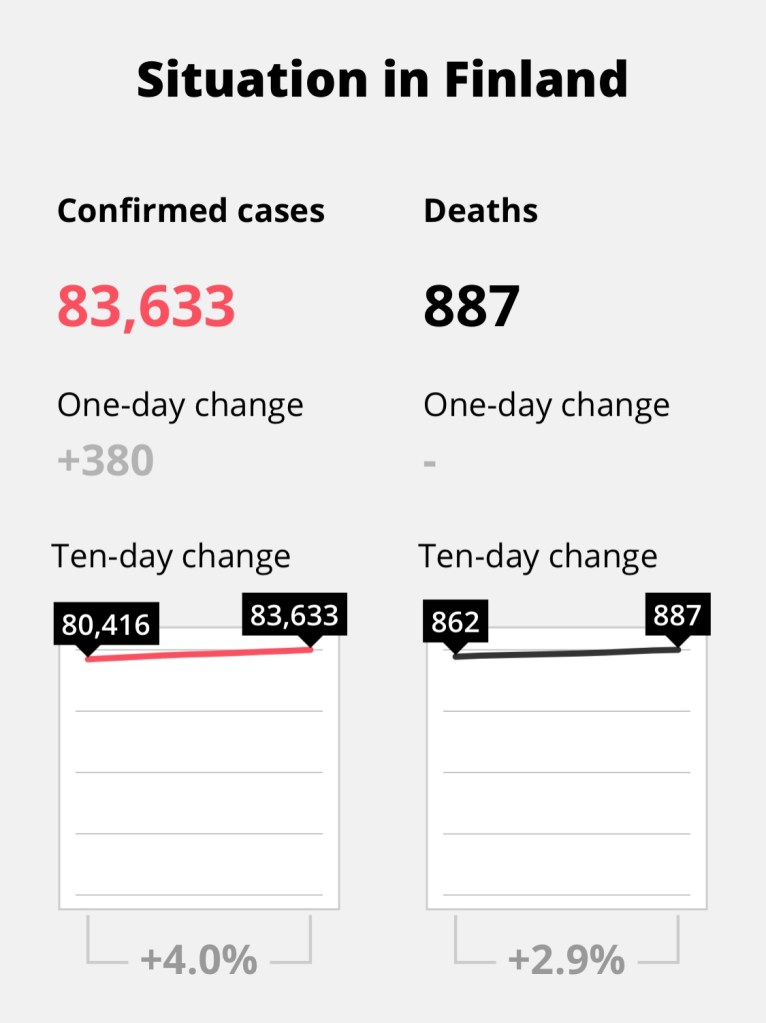
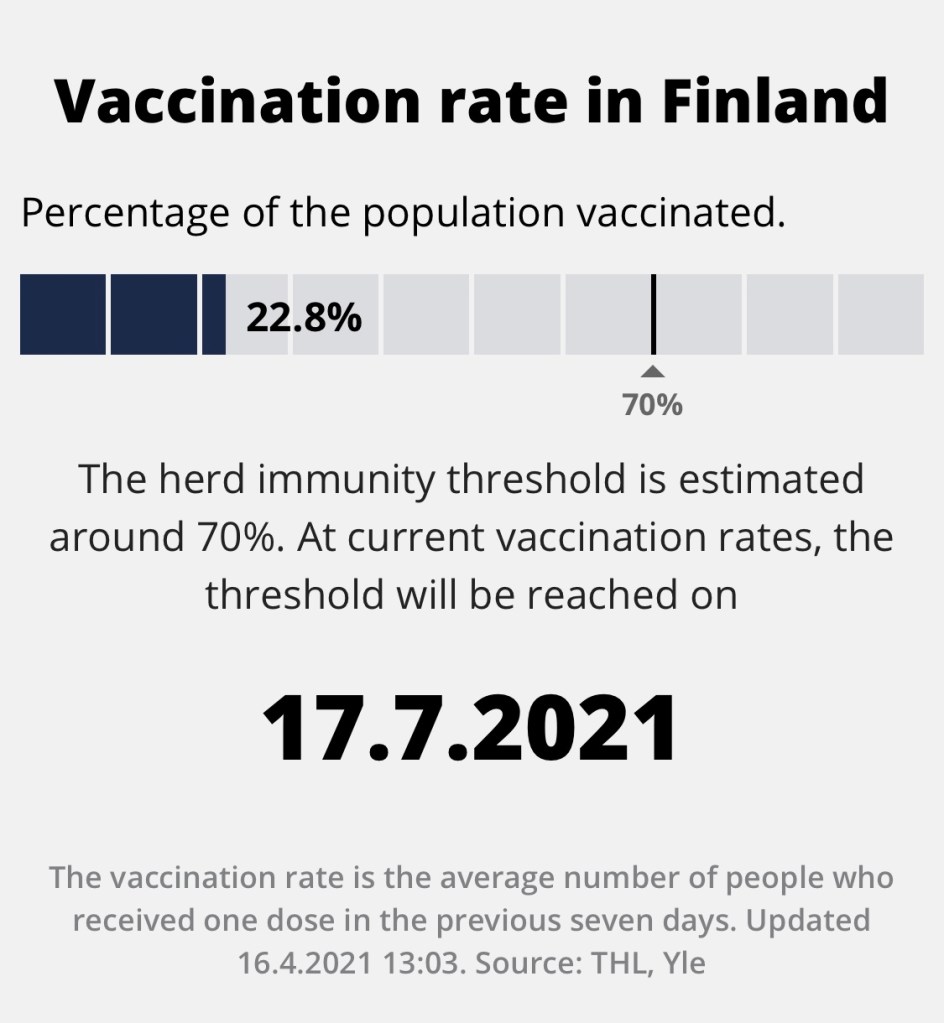
Mas, se você está curioso, vamos aos números finlandeses:
📷 Yle
Para quem quiser acompanhar, o site do Yle está atualizando e informando de forma simples de entender todos os dados finlandeses e alguns números dos países (vizinhos) nórdicos em relação ao COVID-19 e você pode ver em inglês, finlandês ou sueco essas informações.
É possível ver que os números estão bem abaixo em relação a outros países. E as estratégias de contenção foram notícia em vários tabloides internacionais, embora, na minha opinião, as estratégias são basicamente as mesmas que muitos países vêm adotando: restaurantes funcionando no sistema delivery ou take away, seja aglomerações, quando possível as aulas e trabalhos são feitos em casa, máscaras quando em público e higiene das mãos.
No momento a preocupação é com o verão chegando, já que ano passado os números aumentaram bastante ao fim do verão depois do pessoal viajar de férias. Então a estratégia agora é baixar bem os casos em abril e maio e vacinar se possível toda a população até meados de julho. Já há no site do governo as informações de restrições para os meses seguintes, a ideia é que haja uma certa normalidade no verão.
Se vai estar tudo normal no verão, eu não sei. Só sei que, pessoalmente, me sinto bem abençoada de, especialmente neste momento, estar morando aqui.
EN
The most expected invitation of the year came to me last week. A text message from the city for me to schedule my time for the COVID-19 vaccine. So I decided to share with you an update on the situation in Finland regarding the pandemic.
First of all, I would like to say that no, the vaccine is not in my age group yet. At home, only I received the vaccine, as I am diabetic. The vaccination is still among the elderly and those at risk groups.
In this link you can see, for example, in which order the vaccines are being given. Starting with the professionals who are taking care of patients with COVID-19, going through elderly people over 80, between 75-79, between 70-74 years of age and now whose are in risk groups with a predisposition to the worsening of the disease. When the number of vaccinees is significantly high, then those who are in good health will be called. Anyway, it follows kind the order that most countries are also following.
As a Brazilian, I can say that the situation in Finland is very good regarding the COVID-19. The number of cases, hospitalized in intensive care and deaths is not comparable to the chaos that is happening in Brazil. And, yes, the numbers in Brazil are so high that they are news here too.
But, if you’re curious, you can check the pictures above with the Finnish numbers.
And if you want to follow, the Yle website is updating and reporting in a simple way to understand all Finnish data and some numbers from the Nordic (neighboring) countries about COVID-19 and you can also see this information in English, Finnish or Swedish.
As you can see the numbers are well below those of other countries. And the containment strategies were news in several international tabloids, although, in my opinion, the strategies are basically the same that many countries have been adopting: restaurants operating in the delivery or take away system, not be it agglomerations, when possible, classes and jobs are done at home, masks when in public and hand hygiene.N
At the moment the concern is with the summer coming, since last year the numbers increased a lot at the end of the summer after people traveled abroad on vacation. So the strategy now is to lower the cases in April and May and vaccinate the entire population if possible by mid-July. There are already restrictions information for the following months on the government website, the idea is that there will be a certain normality in the summer.
If everything will be normal in the summer, I don’t know. I just know that, personally, I feel very blessed to be living here, especially at this moment.



 quase finlandesa