Como faz o cachorrinho? | What does the dog says?

PT

Meu filho já está com quase dois anos e ele ainda não fala. Isto poderia ser algo preocupante, mas a situação é um pouco diferente quando ensinamos três idiomas ao mesmo tempo. A fala acaba levando mais tempo para acontecer.

Somos uma família multicultural, eu sou brasileira (falo português), meu esposo é finlandês (fala, obviamente, finlandês) e nosso relacionamento sempre foi em inglês. Então os três idiomas estão sempre presentes no nosso dia a dia e nós estimulamos nosso pequeno em todos estes idiomas.

Nosso foco é o português e o finlandês por serem nossas línguas maternas. Então, no caso, eu (e minha família nas chamadas de vídeo) falo com ele somente em português e meu esposo (e sua família) somente em finlandês. Mas nós nos comunicamos em inglês, e certamente ele acaba acompanhando nossas conversas também, também apresentamos músicas e vídeos infantis em inglês, além de ter nossa rotina espiritual em inglês também.

Parece confuso, mas acontece muito naturalmente. Ele se acostumou tanto que se eu converso em finlandês com alguém, ele sempre me olha como se fosse estranho pra ele o fato de eu estar falando finlandês também (ou talvez seja apenas o meu sotaque estrangeiro… vai saber…).

Bom, ele fala algumas palavrinhas… nos três idiomas. Por exemplo, ele me chama de äiti (mamãe em finlandês), o pai dele de papai (em português), os vovôs de pappa (em finlandês) e bye bye (em inglês). Ele entende os três idiomas, a gente consegue identificar bem isso e isso é o que mais importa.

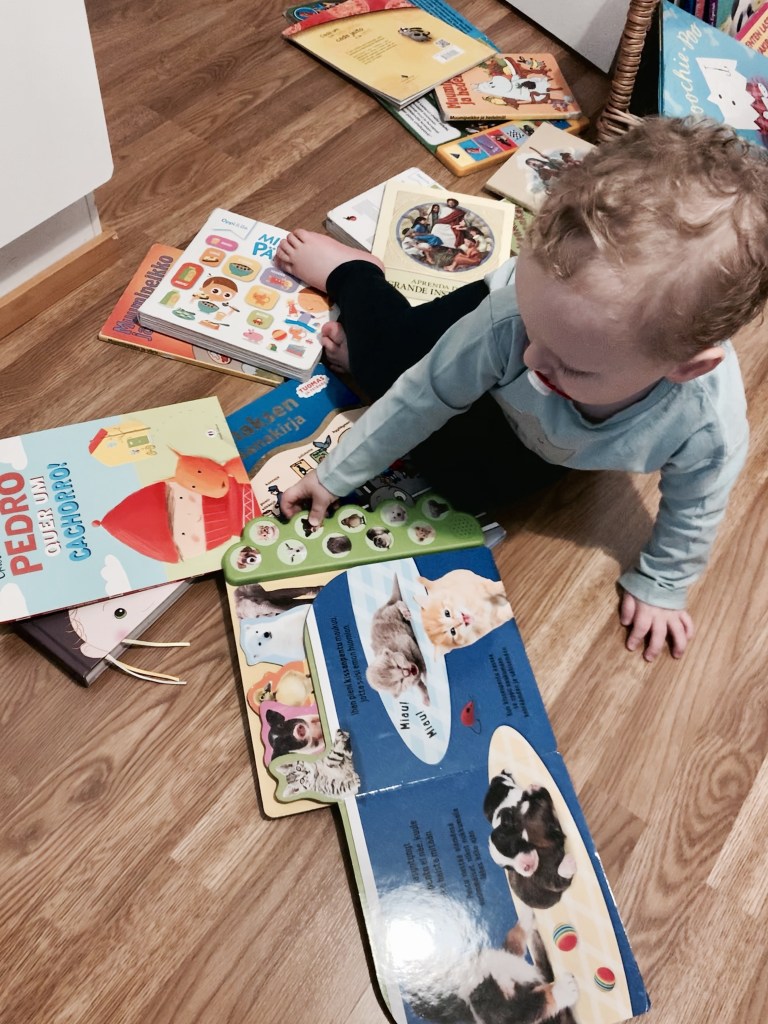
Há algum tempo ele começou a fazer os sons de coisas e animais. E nós percebemos um pouco como os idiomas acabam se misturando um pouco na cabecinha dele, ele meio que acabou criando “seus próprios sons”. Por exemplo, ele não diz au-au, mas diz “ou-ou” quando vê um cachorrinho.

Então, hoje decidi mostrar pra vocês alguns desses sons em finlandês, pra que vocês possam ver as diferenças. Aliás, vocês sabiam que a descrição de alguns sons podem ser bem diferentes de uma língua para outra? Pois é, só agora com um pequeno em casa, que a gente se preocupa em ensinar os sons pra ele, é que eu fui perceber isso.

Então aqui vai uma pequena listinha de sons de animais.

E aí, muito diferente?


EN

My son is almost two years old and he still doesn’t speak. This could be worrying, but the situation is a little different when we teach three languages at the same time. Speech ends up taking longer to happen.

We are a multicultural family, I am Brazilian (I speak Portuguese), my husband is Finnish (he obviously speaks Finnish) and our relationship has always been in English. So the three languages are always present in our daily lives and we encourage our little one in all these languages.

Our focus is Portuguese and Finnish as they are our mother tongues. So, in this case, I (and my family on video calls) speak to him only in Portuguese and my husband (and his family) only in Finnish. But we communicate in English, and our son certainly ends up following our conversations too, we also present children’s songs and videos in English, in addition to having our spiritual routine in English as well.

It looks confusing, but it happens very naturally. He got so used to it that if I talk to someone in Finnish, he always looks at me like it’s strange to him to see me speaking also Finnish (or maybe it’s just my foreign accent… who knows…).

Well, he does speaks a few words… in all three languages. For example, he calls me äiti (mommy in Finnish), his daddy as papai (in Portuguese), grandpas as pappa (in Finnish) and bye bye (in English). He understands all the three languages, we can clearly identify that and that is what matters most.

Some time ago he started making the sounds of things and animals. And we noticed a how the languages end up kinda mixing a little bit in his head, he kind of ended up creating “his own sounds”. For example, he doesn’t say woof-woof, but he says “ou-ou” when he sees a dog.

So today I decided to show you some of these sounds in Finnish, so that you can see the differences. In fact, did you know that the description of some sounds can be very different from one language to another? Well, it is only now with a little boy at home, that we are concerned with teaching him sounds, that we realized that.

So here’s a little list of animal sounds.

So, very different?
Kantarellikeitto

PT

Olha quem resolveu aparecer pra cumprir o prometido! Sim, hoje vou postar a receita que prometi no último post: Kantarellikeitto!

A receita é muito simples, tem um sabor marcante (tanto que nos restaurantes, geralmente, é servida como entrada, em porção pequena, ao invés de prato principal), mas deliciosa!

Como disse no post anterior, a gente aqui consome bastante cogumelos silvestres. Um dos meus preferidos é o kantarelli (ou chanterelle, em inglês). Ele é todo amarelinho, bonitinho, parece um trompete e tem um gostinho de dar água na boca!

Nem eu e nem meu marido tínhamos feito essa receita antes, então pesquisamos algumas receitas diferentes até chegar no que fizemos.

Kantarellikeitto

Bom, não vou me ater muito à quantidade de ingredientes, porque acho que isso vai variar do quão forte você quer sua sopa, mas os ingredientes são: cogumelos kantarelli (preferencialmente frescos, mas dá pra adaptar com os secos também), manteiga, cebola, alho, pimenta do reino, sal, farinha de trigo, caldo de legumes e creme de leite fresco.

Pra ter uma ideia, um litro de cogumelos frescos rende mais ou menos 4 porções grandes de sopa.

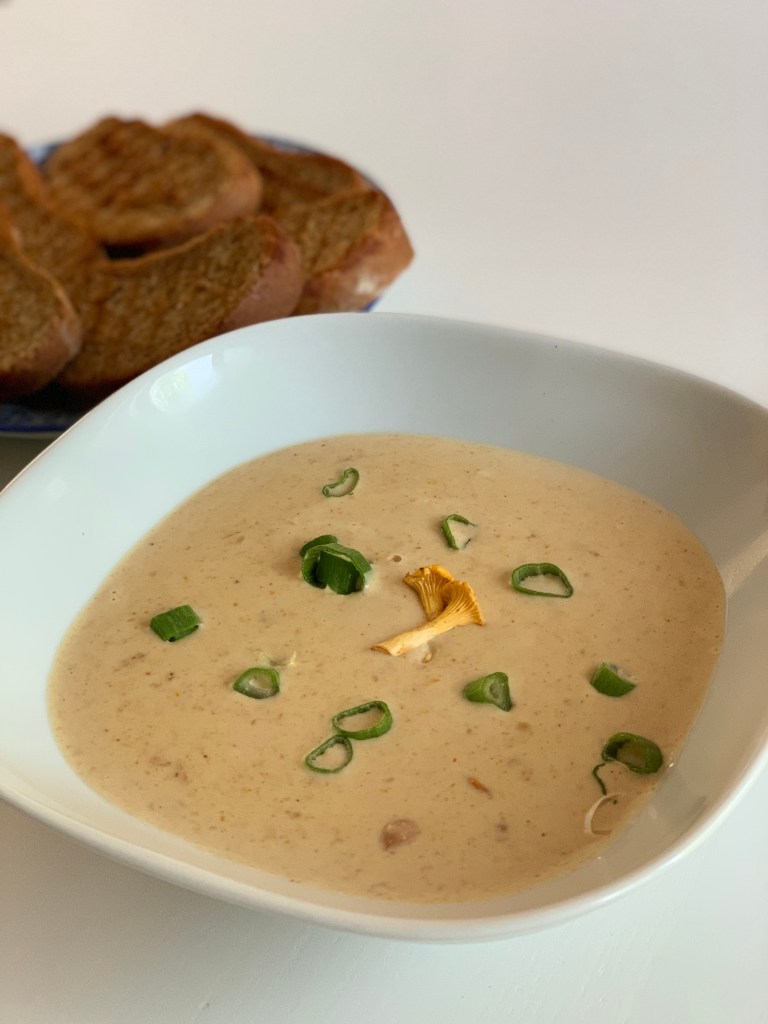
A ideia é fazer um creme, então, comece fritando alho e cebola na manteiga. Por aqui a gente resolveu fazer os cogumelos de três formas diferentes: a maior parte, batemos no liquidificador com o creme de leite fresco, outra parte picamos e fritamos e deixamos uns menorzinhos para decorar o prato. Então, com cebola e alho fritos, adicione os cogumelos e frite até que não estejam mais aguados. Adicione farinha de trigo e adicione o caldo de legumes já com água até formar uma massinha, adicione o creme com cogumelos, pimenta do reino, sal (aqui nos adicionamos um pouco de queijo, porque queijo nunca é demais aqui em casa) e deixe cozinhar por aproximadamente 10 minutos.

E pronto, delicie-se!


EN

Look who decided to show up! Yes, today I will post the recipe I promised in the last post: Chanterelle’s soup!

The recipe is very simple, it has a strong flavor (so much that in most of restaurants, it is served as a starter, in a small portion, instead of the main dish), but delicious!

As I said in the previous post, we eat a lot of wild mushrooms here. One of my favorites is chanterelle. He’s all yellow, cute, looks like a trumpet and has a mouth-watering taste!

Neither my husband nor I had made this recipe before, so we researched a few different recipes until we got to what we made.

Chanterelle’s soup

Well, I’m not going to stick to the amount of ingredients, because I think it will vary how strong you want your soup, but the ingredients are: kantarelli mushrooms (preferably fresh, but you can adapt the recipe with the dried ones too), butter, onion, garlic, black pepper, salt, wheat flour, vegetable broth and cream.

You can have an ideia that a liter of fresh mushrooms makes about 4 large portions of soup.

The idea is to make a cream, then start frying garlic and onion in butter. Here we decided to make the mushrooms in three different ways: most of them, we blend the with cream, the other part we chop and fry and a few little nice looking ones to decorate. Then, with fried onion and garlic, add the mushrooms and fry until they are no longer watery. Add wheat flour and add the vegetable broth already with water until it forms a smooth dough, add the cream with mushrooms, black pepper, salt (here we add a little cheese, because cheese is never too much here at home) and let it cook for approximately 10 minutes.

And now is all about to taste it!

A melhor época do ano: cogumelos por toda parte | The best time of the year: mushrooms everywhere

PT

Final de verão, começo de outono… e eu queria dizer que, definitivamente, é a melhor época do ano por aqui. Não somente pelo calorzinho agradável, pelo sol da meia-noite, pelo bom humor das pessoas, pelas florestas e verdes em todo lugar, mas, principalmente, pelas gostosuras que encontramos na floresta! Estão ali de graça pra quem quiser pegar: framboesas, blueberries, lingonberries, cloudberries e, os meus preferidos, cogumelos!

O meu post de hoje é sobre esses saborosos cogumelos que temos por aqui. Resolvi escrever um pouquinho sobre eles porque sempre que eu posto no meu Instagram pessoal, várias pessoas me perguntam sem não são venenosos, se a gente come eles, etc.

Pois bem, claro há muitos cogumelos venenosos e não comestíveis. E o segredo é saber identificar quais são comestíveis e quais não são. Além de saber como prepará-los, já que alguns são comestíveis apenas após o cozimento.

Pessoalmente, não sei todos os comestíveis, mas já identifico 4 tipos de cogumelos. Os cogumelos que eu consigo identificar são talvez os mais comuns por aqui, mais fáceis de encontrar na floresta e são também os meus favoritos.

Se você mora por aqui e quer ir à caça dos cogumelos, você vai precisar de uma faca pequena, um balde, um pincel (por que o pincel? porque cogumelo não se lava, se tira a terra dele apenas) e bastante disposição, porque se anda bastante e tem muito agachamento também… Agora, onde se encontram os cogumelos? Resposta simples: na floresta. Onde na floresta? Aí é que vem o desafio. Ou você anda e descobre sozinho, ou você consegue o milagre de algum finlandês te contar o maior segredo por aqui.

Sim, o local dos cogumelos é sempre um segredo. Por quê? Não sei. Talvez porque é quase uma caça ao tesouro, já que se quiser comprar estes cogumelos você vai precisar desembolsar muitos e muitos Euros. Mas, o máximo que consegui até hoje foi uma direção básica, mas não especificada. E me lembro uma ocasião que estava na floresta com meu marido, já há bastante tempo, e achei uma área cheia de mustatorvisieni, eu chamei ele quase gritando e dizendo que achei, ele rapidamente veio e me pediu pra falar baixo porque às vezes alguém poderia escutar… hoje eu entendo e guardo pra mim o caminho do tesouro.

Vamos conhecer os cogumelos que temos por aqui, pelo menos os que eu conheço:

mustatorvisieni: muita gente chama também de chanterelle preto, porque seu formato é igual, tem o formato de um trompete; é rico em potássio; fica delicioso em creme ou sopa.
kantarelli: esse talvez seja o mais fácil de encontrar na floresta, porque tem essa cor amarela vibrante e se destaca entre os galhos, musgos e folhagens; tem um formato de trompete também e pode ficar grande do tamanho de uma mão adulta; dele se faz um dos pratos típicos finlandeses mais conhecidos: kantarellikeitto (sopa de chanterelle); também tem bastante potássio (mas umas dez vezes menos que o mustatorvisieni), embora o que chama atenção nele é uma boa quantidade de vitamina A e D.
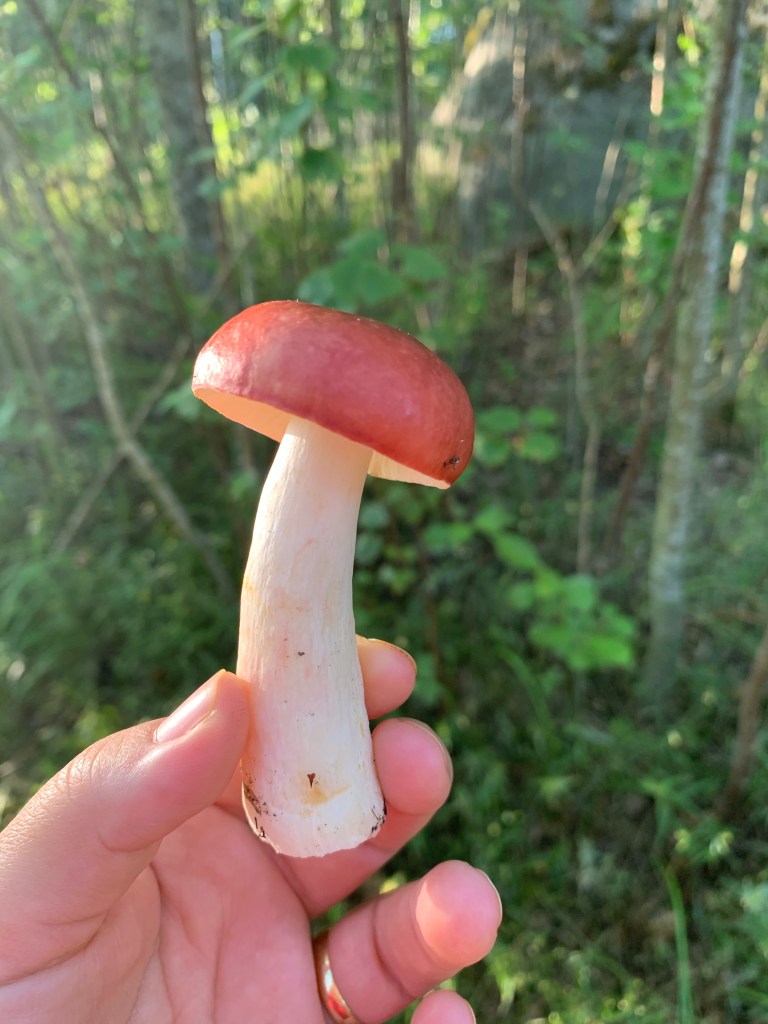
viinihapero: este é o favorito do meu marido, a gente corta ele e frita com um pouquinho de manteiga, fica parecendo carne; ele tem irmãozinhos, dependendo da cor do seu topo: marrom, amarelo ou branco; tem bastante vitamina C, potássio e fósforo; esse da foto está bem novinho, mas ele pode ficar bem grandão e o topo pode até virar um pouquinho pra cima.
suppilovahvero: este aqui uns amigos meus do Brasil que estiveram por aqui, vão reconhecer… porque foram à caça deles com meus sogros; também da família do chanterelle;

Claro que existem muitos outros cogumelos comestíveis na floresta, ainda me falta conhecer (e saborear) vários deles! Por isso, vou deixar aqui alguns links que podem ajudar na identificação. Lembrando que estes são os silvestres, aqueles que encontramos na floresta, ainda têm os que são produzidos e mais amplamente comercializados.

Em finlandês: https://www.ruokatieto.fi/ruokakasvatus/ruokaketju-ruuan-matka-pellolta-poytaan/luonto/sienet/metsasienia

Em inglês: http://www.dlc.fi/~marian1/gourmet/i_mushro.htm

No próximo post vou postar uma receita bem típica finlandesa que fiz aqui em casa usando cogumelos. Até a próxima!


EN

Late summer and beginning of autumn it is definitely the best time of the year around here. Not only for the pleasant warmth, the midnight sun, the good mood of the people, it is also green everywhere, but, mainly, for the deliciousness that we find in the forest! Free for whose want to pick them up: raspberries, blueberries, lingonberries, blackberries and, my favorites, mushrooms!

My post today is about these tasty mushrooms that we have here. I decided to write a little bit about them because whenever I post on my personal account in Instagram, several people ask me if they are not poisonous, if we eat them, etc.

Well, of course there are many poisonous and inedible mushrooms. And the secret is to know which ones are edible and which are not. In addition to knowing how to prepare them, since some are edible only after boiling.

Personally, I don’t know all the edibles, but I can already identify 4 types of mushrooms. The mushrooms that I can identify are perhaps the most common here, the easiest to find in the forest and are also my favorites.

If you live here and are willing to go for mushroom picking, you will need a small knife, a bucket, a brush (why the brush? to clean the dirty from the mushroom since it is not washable) and a lot of disposition since you will walk a lot and have a lot of squats too… Now, where are the mushrooms? Simple answer: in the forest. Where in the forest? Well that is the biggest challenge. Either you walk around and find out for yourself, or you get some Finn to tell you the biggest secret around here.

Yes, the location of the mushrooms is always a big secret. Why? Who knows? Perhaps because it is almost a treasure hunt, since if you want to buy these mushrooms you will need to pay many, many Euros. About where to find them, the most I’ve got so far is a basic, but unspecified, direction. And I remember one occasion that I was in the forest with my husband, for a long time, and I found an area full of mustatorvisieni, I called him almost shouting and saying I found it, he quickly came and asked me to speak quietly because sometimes someone could be listening… well, now I understand this secret and keep the treasure path for myself.

So let’s get to known the mushrooms we have around here, at least the ones I know:

mustatorvisieni: many people also call it black chanterelle, because its shape is similar, it has the shape of a trumpet; it is rich in potassium; it’s delicious in cream or soup.

kantarelli: this is perhaps the easiest to find in the forest, because it has this vibrant yellow color and stands out among branches, mosses and foliage; it has a trumpet shape and can sometimes be as big as the size of an adult hand; it makes one of the most well-known Finnish typical dishes: kantarellikeitto (chanterelle soup); it also has a lot of potassium (but about ten times less than the mustatorvisieni), although what draws attention to it is a good amount of vitamin A and D.

viinihapero: this is my husband’s favorite, we cut it and fry it with butter, it looks like meat; it has “relatives”, depending on the color of its head: brown, yellow or white; it has vitamin C, potassium and phosphorus; the one in the photo is very new, but it can be very big and the top can even turn up a little bit.

suppilovahvero: this one my friends from Brazil will recognize it… because they went hunting for them with my in-laws; also from the chanterelle family;

Of course there are many other edible mushrooms in the forest, I still need to know (and taste) most of them! Therefore, I will leave here some links that can help in the identification. Recalling that these are the wild ones, those we find in the forest, still have those that are raised and more widely sold.

In Finnish: https://www.ruokatieto.fi/ruokakasvatus/ruokaketju-ruuan-matka-pellolta-poytaan/luonto/sienet/metsasienia

In English: http://www.dlc.fi/~marian1/gourmet/i_mushro.htm

Next post I will share a very typical Finnish recipe that I made here at home using mushrooms. See you!